
CLIMATE
CREDITS
WHAT IS A CLIMATE CREDIT?

A Climate Credit is an environmental compensation tool based on the Forest Climate Credit System of Catalonia (Agreement GOV/270/2023). It boosts CO₂ capture, as well as the improvement of natural resources such as water and biodiversity.
It allows companies, institutions, citizens and visitors to offset their ecological footprint – both carbon and water – by financing certified forest regeneration projects. This contributes to the goal of climate neutrality and strengthens the resilience of the territory in the face of climate change.
WHAT IS A PROMACC?

PROMACC (Operational Projects for Mitigation and Adaptation to Climate Change) are 3- to 4-year initiatives led by groups of forest owners, with the aim of regenerating the landscape and increasing its resilience to climate change.
These actions are developed within the framework of the Forest Climate Credit System of Catalonia, promoted by the Generalitat de Catalunya. Companies and institutions collaborate by financing the projects and participating in awareness-raising activities, promoting a commitment to sustainability and environmental conservation.
how do we measure it?
The methodology applied in the PROMACC project in the Muga Valley evaluates the impacts in three key vectors: CO₂ capture, blue water generation and biodiversity improvement. Through forestry actions, the carbon absorption and water efficiency of the forest is optimized, contributing to mitigating climate change and conserve natural resources.
- CO₂ sequestered and avoided.
- Water impacts
- Biodiversity
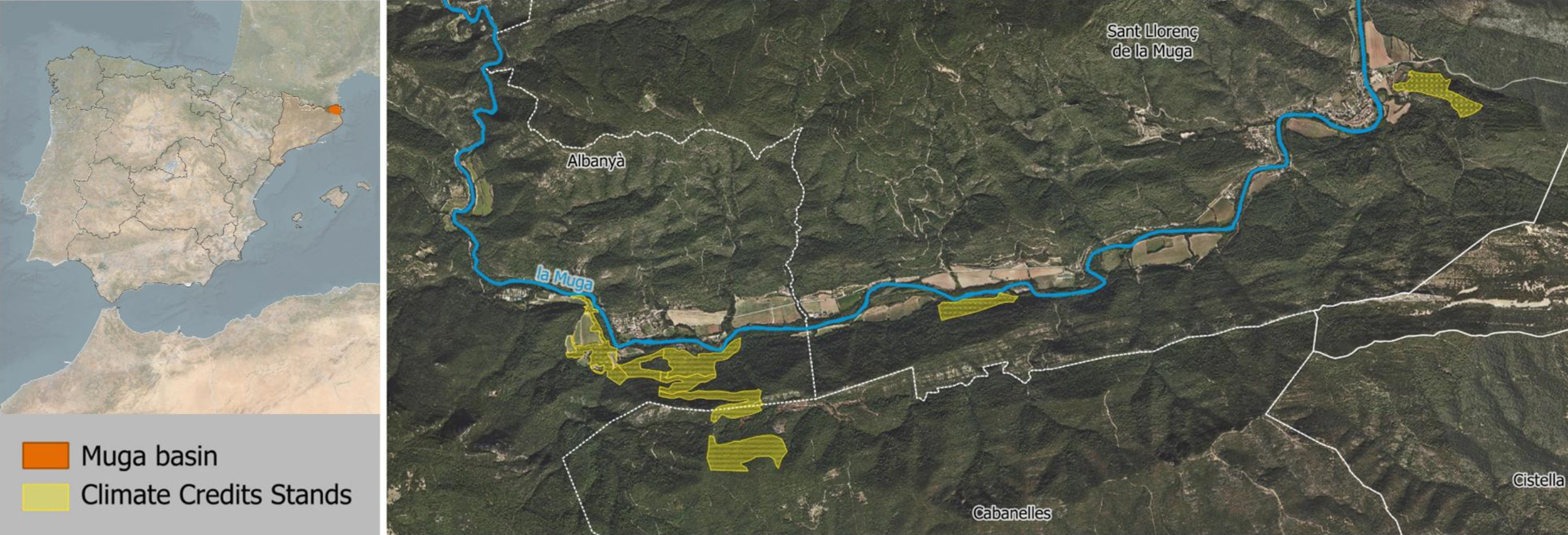
Areas of Action:
Albanyà, Cabanelles and
Sant Llorenç de la Muga
Learn more about the climate credit pilot project
A total of 57.8 hectares have been selected in six private estates in three municipalities – Albanyà, Cabanelles and Sant Llorenç de la Muga – to carry out forestry interventions aimed at landscape regeneration. Each action has a specific plan to improve the forest structure, increase the vitality of the ecosystem, optimize water production, and promote biodiversity.
Planned actions include:
– strategic thinning of forest stands,
– selective brush clearing, and
– conservation of key elements supporting native fauna and flora